Hanon: The Virtuoso Pianist in 60 Exercises ─ A Comprehensive Guide
Hanon’s Virtuoso Pianist, available as a complete PDF, presents 60 exercises designed for technical mastery. These exercises build finger strength and dexterity.
Charles-Louis Hanon (1820-1900) was a French pianist, composer, and pedagogue renowned for his influential piano exercises. His most famous work, The Virtuoso Pianist in Sixty Exercises, remains a cornerstone of piano technique training globally. Available as a complete PDF, this collection isn’t about composing beautiful melodies, but rather about building a solid technical foundation.
Hanon’s exercises focus on developing finger independence, evenness of touch, and hand strength. He believed in a systematic approach to technique, and his exercises are designed to be practiced diligently and repeatedly. While sometimes criticized for being mechanical, they provide a crucial building block for aspiring pianists, preparing them for tackling more complex repertoire. The enduring popularity, evidenced by readily available PDF versions, speaks to its lasting impact.
The Historical Context of Hanon’s Exercises
Charles-Louis Hanon’s exercises emerged in the 19th century, a period of significant development in piano technique and performance practice. The rise of virtuoso pianists demanded increasingly complex technical skills, and Hanon aimed to provide a systematic method for achieving them. His Virtuoso Pianist, now widely accessible as a complete PDF, reflects this era’s emphasis on mechanical proficiency.
Interestingly, even during his lifetime, Hanon’s work faced scrutiny. Debussy, for example, had a complex relationship with the exercises. The context of World War I influenced perspectives on technical drills. Despite criticisms, the exercises’ practicality ensured their continued use in piano pedagogy, readily distributed as a PDF resource, solidifying their place in musical education.
Understanding Piano Technique and Hanon’s Approach
Hanon’s approach centers on isolating and strengthening individual finger movements, promoting independence and evenness. His exercises, conveniently available as a complete PDF, focus on repetitive patterns designed to build muscle memory and overcome technical challenges. This method emphasizes a mechanical foundation, believing that mastery of basic movements unlocks expressive playing.
The exercises aren’t intended as musical pieces themselves, but rather as tools for developing the physical skills necessary for interpreting repertoire. The PDF format allows for easy access to these foundational studies. While some criticize the lack of musical context, proponents argue that Hanon provides a crucial building block for advanced technique, preparing pianists for diverse styles.

The Hanon Exercises: A Detailed Overview
Hanon’s 60 exercises, found in the complete PDF, systematically address finger dexterity, strength, and independence through repetitive patterns and increasing complexity.
Exercise Structure and Principles
Hanon’s exercises, readily available in a complete PDF format, are built upon a foundation of sequential finger patterns. Each exercise typically begins with a simple melodic or harmonic idea, then systematically progresses through all keys.
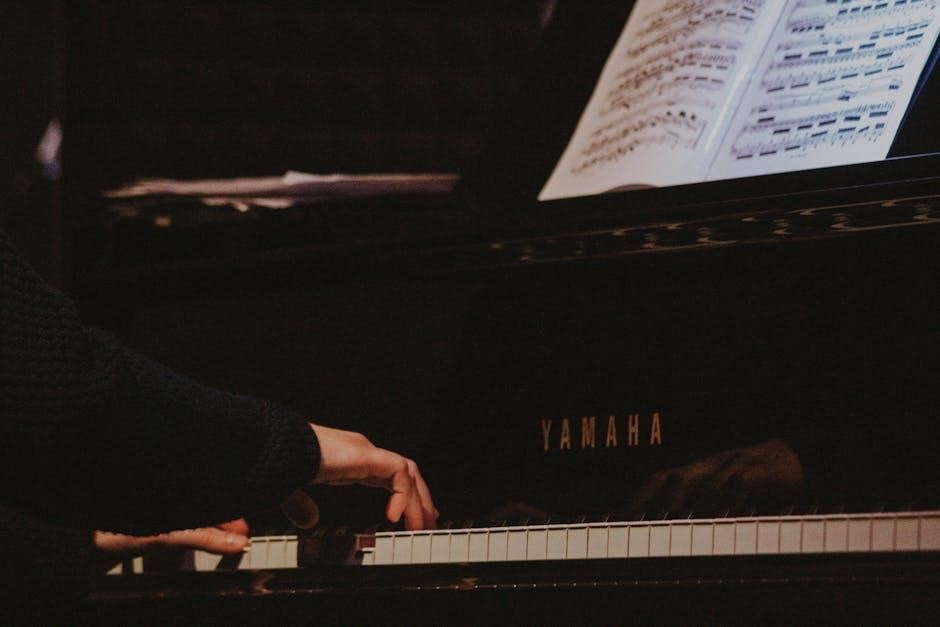
The core principle involves repetitive practice of these patterns, focusing on evenness of touch, finger independence, and consistent rhythm. Exercises often feature notes repeated in groups, demanding precise finger control.
The structure emphasizes gradual increases in difficulty, starting with basic five-finger patterns and expanding to encompass wider intervals and more complex rhythms. The PDF provides clear notation, allowing pianists to meticulously follow the prescribed fingerings and dynamics, crucial for maximizing technical development.
The Core 60 Exercises: A Categorization
The 60 exercises within Hanon’s Virtuoso Pianist, accessible as a complete PDF, can be broadly categorized by their primary technical focus. Initial exercises (1-20) concentrate on basic finger dexterity and evenness, establishing a solid foundation.
Subsequent exercises (21-40) introduce more complex rhythmic patterns and wider intervals, challenging finger independence and coordination. The final set (41-60) often incorporates arpeggiated figures and scales, demanding greater hand agility and speed.
This categorization isn’t rigid; many exercises overlap in their technical demands. The PDF allows for focused practice, enabling pianists to target specific weaknesses and build a comprehensive skillset. Understanding these categories aids in structuring a productive practice routine.
Hanon’s Op. 821: Exercises, Op. 821 (PDF Availability)
Hanon’s Exercises, Op. 821, commonly known as the 60 exercises, is widely available as a complete PDF download. This collection, a cornerstone of piano technique, focuses on developing finger independence, strength, and evenness. Numerous online resources offer free PDF copies, ensuring accessibility for students and teachers alike.
The PDF format allows for easy printing and annotation, facilitating focused practice. Digital versions often include zoom functionality for detailed study of the notation. While various editions exist, the core content remains consistent across all versions of the complete PDF.
Ensure the PDF source is reputable to guarantee accuracy and completeness of the exercises.

Benefits of Practicing Hanon Exercises
Hanon exercises, found in the complete PDF, cultivate finger independence, hand strength, and dexterity, ultimately enhancing a pianist’s technical proficiency and speed.
Developing Finger Independence
Hanon’s exercises, readily available in the complete PDF version of The Virtuoso Pianist, are fundamentally designed to foster independent finger movement. Each exercise systematically isolates and strengthens individual fingers, breaking down the natural tendency for fingers to move in unison.
The repetitive nature of these exercises, particularly those found within the first thirty exercises, compels the pianist to consciously control each finger, improving its individual articulation and responsiveness. This focused practice combats reliance on group movements, allowing for greater nuance and control in complex passages.
By consistently working through the Hanon exercises, pianists develop the ability to execute intricate musical phrases with clarity and precision, a cornerstone of advanced piano technique.
Improving Hand Strength and Dexterity
The complete PDF of Hanon’s The Virtuoso Pianist offers a progressive series of exercises specifically targeting hand strength and dexterity. Repeatedly navigating the patterns within these 60 exercises builds muscular endurance in the hands and forearms, crucial for extended practice sessions and demanding repertoire.
The exercises demand precise finger placement and consistent pressure, strengthening the intrinsic muscles of the hand. This increased strength translates to improved control and responsiveness at the keyboard. Furthermore, the rapid repetition inherent in Hanon’s method enhances finger dexterity, allowing for quicker and more agile movements.
Consistent practice with the Hanon exercises cultivates a resilient and adaptable hand, capable of tackling a wide range of technical challenges.
Enhancing Evenness of Touch
Hanon’s The Virtuoso Pianist, readily available as a complete PDF, profoundly enhances evenness of touch. The exercises, particularly those involving repeated notes, force the pianist to develop consistent finger pressure and articulation; This focused repetition minimizes variations in volume and tone across all fingers.
The structured nature of the exercises—often utilizing scales and arpeggios in varied rhythmic patterns—demands equal weight and timing from each finger. This cultivates a smooth, legato sound and eliminates unwanted accents.
By diligently working through the Hanon exercises, pianists refine their ability to produce a uniform and controlled tone, essential for expressive musical phrasing and polished performances.
Increasing Speed and Accuracy
Accessing Hanon’s The Virtuoso Pianist as a complete PDF unlocks a pathway to heightened speed and accuracy. The exercises systematically build technical proficiency, starting with slower tempos and gradually increasing the pace. This methodical approach ensures clean execution before attempting greater velocity.
Repeated practice of these exercises strengthens neuromuscular connections, allowing fingers to navigate the keyboard with greater precision and efficiency. The focus on correct fingering, detailed within the PDF, minimizes errors and promotes fluid movement.
Ultimately, consistent Hanon practice translates to faster, more accurate playing, enabling pianists to tackle challenging repertoire with confidence and control.

Navigating the Hanon PDF: What to Expect
The complete PDF of Hanon: The Virtuoso Pianist contains 60 exercises with detailed notation, fingerings, and tempo markings for focused piano technique development.
Understanding the Notation
Hanon’s exercises, as presented in the complete PDF, utilize standard musical notation. Each exercise features a staff with clef signs, notes representing specific pitches, and rhythmic values indicating duration. Pay close attention to repeated notes and groupings, as these are central to the technique. The PDF clearly displays finger numbers above each note, guiding correct digit placement. Understanding these fingerings is crucial for efficient practice and avoiding tension.
Observe the time signature, dictating the number of beats per measure. The notation also includes dynamic markings – piano (soft), forte (loud), and variations – influencing the volume and expression. Recognizing these elements within the Hanon PDF unlocks a deeper understanding of the exercises and facilitates effective technical development. The document contains a series of finger exercises numbered 1 to 30 for piano practice.
Tempo Markings and Dynamics
The complete PDF of Hanon’s exercises includes tempo markings, typically indicated with Italian terms like Allegro (fast) or Andante (walking pace), and metronome markings (beats per minute). Start slowly, prioritizing accuracy before gradually increasing speed. Dynamics – piano (soft), forte (loud), mezzo piano, and mezzo forte – are also present, shaping the musicality even within these technical studies.
Consistent dynamic contrast is vital; avoid playing everything at a single volume. The PDF notation guides these variations. Experiment with crescendos (gradually louder) and diminuendos (gradually softer) to develop control. Mastering tempo and dynamics alongside finger technique transforms Hanon from a purely mechanical exercise into a musically expressive practice.
Fingerings and Their Importance
The complete PDF of Hanon’s exercises provides suggested fingerings – numbers indicating which finger to use (1=thumb, 5=pinky). These aren’t arbitrary; they’re designed for efficiency and to build specific technical skills. Following the suggested fingerings initially is crucial, even if they feel awkward.
Consistent fingering develops muscle memory and prevents inefficient movements. While experienced pianists may adapt fingerings later, beginners should adhere strictly to the PDF’s indications. Proper fingering minimizes tension and maximizes speed and accuracy. Ignoring fingerings hinders progress and can lead to bad habits. Mastering these finger patterns is fundamental to Hanon’s effectiveness;
Common Challenges and Solutions
Practicing Hanon’s exercises from the complete PDF often presents challenges. Beginners struggle with maintaining evenness of touch and tempo, leading to rushed or uneven playing. Tension in the hands and wrists is another frequent issue. A solution is to start extremely slowly, focusing on relaxation and consistent sound.
Another hurdle is accurately following the prescribed fingerings. Resist the urge to simplify; stick to the PDF’s instructions. If a passage feels impossible, break it down into smaller sections. Regular, short practice sessions are more effective than infrequent, lengthy ones. Remember, patience and consistent effort are key to overcoming these obstacles.
Beyond the Basic 60: Expanding Your Hanon Practice
After mastering the initial 60 exercises from the complete PDF, explore Hanon variations and Peter Deneff’s “Jazz Hanon” for advanced technique.
Hanon Variations and Adaptations
Hanon’s exercises, readily available in a complete PDF format, aren’t meant to be rigidly followed. Musicians frequently adapt them to enhance their practice routines. These variations involve altering rhythms, dynamics, and articulations within the original framework.
For instance, practicing exercises with staccato or legato touch develops nuanced control. Changing the tempo – slowing down for precision or speeding up for agility – adds another layer of challenge. Furthermore, transposing exercises to different keys expands harmonic understanding and finger dexterity across the keyboard.
Creative adaptations include incorporating different time signatures or adding ornamentation. These modifications transform the foundational exercises into personalized technical studies, fostering musicality alongside mechanical proficiency. Exploring these variations unlocks the full potential of Hanon’s method.
Jazz Hanon: Peter Deneff’s Approach
Peter Deneff’s Jazz Hanon reimagines the classic Hanon exercises – often found as a complete PDF – for jazz pianists. Deneff’s approach moves beyond purely mechanical practice, infusing the exercises with jazz harmony and rhythmic concepts.
His 50 exercises focus on developing skills crucial for improvisation, such as chord voicings, scale patterns, and rhythmic displacement. Unlike the original Hanon, Jazz Hanon incorporates seventh chords, altered dominants, and other jazz harmonic elements.
This adaptation transforms the foundational technical work into a direct pathway for jazz piano technique. It bridges the gap between classical exercises and the demands of jazz performance, offering a practical and musical approach to technical development. It’s a valuable resource for aspiring jazz musicians.
Integrating Hanon with Other Technical Exercises (Czerny)
While Hanon’s 60 exercises (available as a complete PDF) focus on finger independence and evenness, supplementing them with Czerny’s exercises provides a more comprehensive technical foundation. Czerny offers a broader range of challenges, including scales, arpeggios, and studies addressing specific technical issues.
Combining Hanon with Czerny allows pianists to address both fundamental finger dexterity and more complex musical demands. Czerny’s Practical Finger Exercises and Octave Studies, often found online, complement Hanon’s focused approach.
This integrated practice routine builds a well-rounded technique, enhancing both speed and musicality. It’s a strategic approach for serious students seeking to maximize their technical proficiency and artistic expression.

Hanon and Famous Pianists: A Historical Perspective
Hanon’s exercises, widely available as a complete PDF, sparked debate among pianists like Debussy, revealing complex views on technical training’s role.
Debussy and Hanon: A Complex Relationship
Claude Debussy’s relationship with Hanon’s exercises, readily found as a complete PDF today, was famously ambivalent. In February 1915, amidst World War I, Debussy addressed the value of these technical studies. While acknowledging their potential for developing finger dexterity, he cautioned against mindless repetition.
Debussy believed that solely focusing on mechanical exercises, like those in The Virtuoso Pianist, could stifle musicality and artistic expression. He advocated for a more holistic approach to piano technique, emphasizing the importance of musical understanding and interpretation. He felt that the strict, regimented nature of Hanon’s exercises could hinder a pianist’s ability to develop a unique and expressive style.
Despite his criticisms, Debussy didn’t entirely dismiss Hanon’s work. He recognized its usefulness for building foundational finger strength, but stressed the need to transcend mere technical proficiency and cultivate genuine musical artistry.
The Role of Hanon in Piano Pedagogy
Charles-Louis Hanon’s The Virtuoso Pianist, often accessed as a complete PDF, has held a significant, though debated, role in piano pedagogy for over a century. It’s frequently used to establish fundamental finger independence, strength, and evenness of touch – crucial elements for beginner and intermediate students.
Many teachers incorporate Hanon’s exercises as a warm-up routine or as targeted practice for specific technical challenges. The systematic approach, progressing through various keys and patterns, provides a structured path for developing dexterity. However, modern pedagogy increasingly emphasizes a more balanced approach.
Critics advocate integrating technical work with musical repertoire from the outset, rather than isolating exercises. Despite this, Hanon remains a common tool, particularly for building a solid technical foundation, readily available for download and study.
Criticisms and Defenses of Hanon’s Method
Hanon’s Virtuoso Pianist, widely available as a complete PDF, faces ongoing criticism. Detractors argue its repetitive nature can lead to mechanical playing, neglecting musicality and expression. Some believe it fosters tension and inhibits natural hand movements, potentially causing injury.
Conversely, defenders emphasize that Hanon is a tool, not an end in itself. Proper application – with mindful attention to relaxation and musical phrasing – can yield significant technical benefits. The exercises build finger strength and independence, essential for tackling complex repertoire.
The debate often centers on pedagogical approach. Integrating Hanon with musical pieces, rather than isolating it, mitigates the risk of mechanical practice, allowing students to apply newfound technique musically.

Resources for Hanon Practice
Numerous free PDF downloads of Hanon’s exercises are available online, alongside interactive trainers and apps to aid practice and progress.
Free PDF Downloads of Hanon Exercises
Hanon’s The Virtuoso Pianist, containing the famed 60 exercises, is readily accessible as a free PDF download from various online sources. The Internet Archive offers a digitized version of Hanon, the virtuoso pianist in sixty exercises, allowing for borrowing and streaming.
Several websites host downloadable PDFs of Hanon’s Op. 821, including individual exercises and the complete collection. These resources provide convenient access to the exercises for students and teachers alike. Furthermore, supplemental materials like Czerny’s Practical Finger Exercises are also available in PDF format, offering complementary technical studies. Always ensure the source is reputable to guarantee a clean and accurate PDF copy for optimal practice.
Online Hanon Trainers and Apps
While a complete PDF of Hanon’s exercises is valuable, several online trainers and apps enhance the practice experience. These digital tools often feature interactive playback, tempo control, and progress tracking, aiding focused technical development. Though specific apps dedicated solely to Hanon are limited, many piano learning platforms incorporate elements of his exercises into their curricula.
Users can find websites offering virtual piano keyboards for practicing fingerings alongside the PDF. Some platforms allow importing Hanon exercises as MIDI files for interactive learning. These resources provide a dynamic alternative to traditional PDF-based practice, offering immediate feedback and personalized learning paths for mastering the 60 exercises.
Recommended Editions and Collections
For accessing Hanon’s exercises, a readily available complete PDF version is a popular starting point. However, physical editions offer a tactile experience and often include editorial insights. Schirmer’s edition of The Virtuoso Pianist is a widely respected choice, known for its clear notation and durable binding. International Music Company also provides reliable print editions.
Consider collections that pair Hanon with supplementary exercises, like those by Czerny, for a more comprehensive technical approach. Exploring editions with fingerings suggested by renowned pianists can also prove beneficial. When selecting an edition, prioritize clarity of print and ease of navigation to maximize practice efficiency alongside the PDF.
Advanced Hanon Techniques
Beyond the basic Hanon exercises – found in the complete PDF – explore variations with different articulations, applying them to scales and arpeggios.
Practicing Hanon with Different Articulations
Expanding beyond rote repetition of the Hanon exercises – readily available in a complete PDF format – significantly enhances their value. Experimenting with diverse articulations transforms these technical drills into musically expressive studies.
Consider practicing each exercise legato, striving for a smooth, connected sound. Conversely, explore staccato, emphasizing detached notes. Introduce marcato for a pronounced, accented touch. Further variations include practicing with a gentle tenuto or a crisp portato.
These articulation changes force focused listening and control, developing a nuanced understanding of touch and phrasing. This approach elevates Hanon beyond mere finger training, fostering musicality alongside technical proficiency. The PDF provides the foundation; articulation provides the artistry.
Applying Hanon to Scales and Arpeggios
Leveraging the technical foundation built by Hanon’s exercises – conveniently found in a complete PDF – can dramatically improve scale and arpeggio playing. Instead of treating scales as separate entities, view them as extensions of Hanon’s patterns.
Apply the fingerings and rhythmic precision honed through Hanon to scale practice. For arpeggios, adapt the exercise structures to encompass chord shapes. This integration reinforces finger independence and evenness of touch across different musical contexts.
Furthermore, transpose Hanon exercises through all keys, then apply those same transpositions to scales and arpeggios. This systematic approach builds a comprehensive understanding of keyboard geography and strengthens technical command. The PDF serves as a springboard for broader musical development.
Hanon for Specific Technical Challenges
Hanon’s exercises, readily available as a complete PDF, offer targeted solutions for common piano technique hurdles; For uneven finger strength, isolate problematic exercises and practice slowly, focusing on equalizing touch. Difficulty with trills? Adapt Hanon patterns to emphasize rapid finger alternation.
Struggling with hand independence? Utilize exercises requiring contrasting rhythms in each hand. The PDF allows for selective practice, addressing weaknesses directly. Remember to analyze why a challenge exists and choose exercises that specifically counter that issue.
Consistent, mindful application of Hanon, guided by the complete PDF resource, transforms technical limitations into strengths, fostering a more fluid and expressive playing style.